Thursday, 16 February 2012

pup tip - house training I

This is also known as "toilet training" for dogs, although it doesn't actually involve toilets, as such, just toilet-ing.  In American publications you might see this referred to as "house breaking".  Basically, it means teaching your dog where it is and is not acceptable to wee and poo.

Start house training as soon as you bring your pup home.  As with all training, timing is the key to early success and you will need to be committed to the cause in the early days.  Remember the consistency I'm always banging on about?  Well, that applies here too.  Big time.  If you catch your puppy in the act of getting ready to wee indoors every time and you say no every time and quickly hustle him outside to do the deed every time, then he will learn very quickly that that is what he must do every time.  If your puppy manages to do an indoor wee without being stopped, then he will learn that he can wee indoors.  Even if only gets away with it sometimes.

So, what happens if you scold your puppy for weeing or pooing indoors?  Even worse - what if you punish him for doing so?  What will happen is he will hide away from you to do it.  That's a fact and that is why you should never, ever scold or punish your puppy for relieving himself indoors.  He has to go somewhere and he simply does not know any better.  It is up to you to teach him where is allowed to go.  You simply show him what he is allowed to do rather than telling him off for doing what he is not allowed to do.  That means you need to keep your eye on him and take him out a lot in the beginning.


Taito squatting for a wee in the garden, aged 8 weeks.


And what do you do when your puppy does his business outside?  As with all training, you give him praise and treats. You act as if he just accomplished the most outstanding feat of puppy amazingness.  Make him feel good about relieving himself in the correct place. 

It's up to you to know when your puppy is likely to need to relieve himself. And, in the beginning, it will be often.  Very often.  These are the times to take your puppy outside for a wee and/or poo:
  • As soon as he wakes up
  • As soon as he finishes eating
  • Every 20 minutes while he is awake or playing
  • If he is busily walking around sniffing the floor, particularly when going in circles
  • Every time he asks to go out
You might need to have a bit of an eagle eye for recognising that your puppy is asking to go out.  They start asking really surprisingly early on.  Even the little 6-and-7-week-olds start asking before they ever leave us here.  But it doesn't necessarily mean your puppy will go up to the door and bark or scratch.  That comes much later.  At first look for the puppy just hanging around or sitting next to the door.  Or keep a watch for your puppy gazing at the door.  Or just barking frantically for no apparent reason.

Neka gave us a challenge.  She was asking to go out really quickly in her training, but her way of asking was a casual glance in our direction as she strolled across the living room towards the back door.  Funny girl.  It took us a while to catch on that this was her sign, but once we spotted it, we had the house training cracked.

For more on house training, have a look at this later post.


Wednesday, 15 February 2012

five (make that 3) more things you should teach your dog

Following on from my earlier post, five things you should teach your dog, here are a few more absolute essentials that didn't make the cut on the original five.

1.  Leave - Also known in some training classes as "Leave It".  The addition of the "it" may have something to do with the fact that dogs hear hard consonants better than soft sounds, so finishing the command on a hard T gives it a bit of extra punch.  Otherwise it can sound to a dog a bit like any other eee-word.  This really is an essential command for every dog.  It's useful for getting him to part with treasures he finds such as tissues, shoes, disgusting things found in fields, or, as in the case of Keskiyo a few years ago, a live and rather surprised pheasant.  Keskiyo, whose leave is really excellent, dropped the pheasant, albeit probably as much in shock at having caught it as in response to my roared command.  Nonetheless, drop it he did, and it survived to wind up another dog on another day.  Leave also works as in "leave that other dog/cat/person alone."


Karhu:  "May I please leave this bath?"
2.  Heel - Otherwise known as walking nicely on a lead.  This can be a tough one for Lapphunds.  Neka took an absolute age to finally stop pulling on her lead, regardless of how much training we did.  And we did a lot.  When she was about 5 months old she actually pulled me over into the street in the path of a bus.  Lappies pack a lot of power for a relatively small dog and they go from 0 to 60 in a split second, usually off to the side, taking your shoulder out of its joint as they go.  There are lots of good products available to help with the really stubborn pullers, and I eventually went the harness and head collar route.  These days she's excellent on her lead.  Unless she sees a squirrell, of course.  Or a cat.  Or occasionally a squirrell-shaped blowing leaf.

3.  Off - This is the all-purpose command to mean "get all 4 paws on the ground".  Use it to mean "get off the sofa," or "get off the street from the path of oncoming taffic and back onto the pavement," or "get off the stairs."  The real biggie, though, for this command is to stop your dog jumping up on people.  Some are happy to have their dog jumping up occasionally for a quick cuddle.  After all, it's certainly easier to reach them when they jump up to you rather than you bending down to their level.  However, if you do that you need to beware that they will forevermore equate jumping up on people with affection and therefore they will jump up on other people at every opportunity.  Don't let your dog jump up on other people, people.  Little folks don't do too well with dogs jumping up on them.  Equally old folks.  Not to mention folks dressed in their nice clothes.


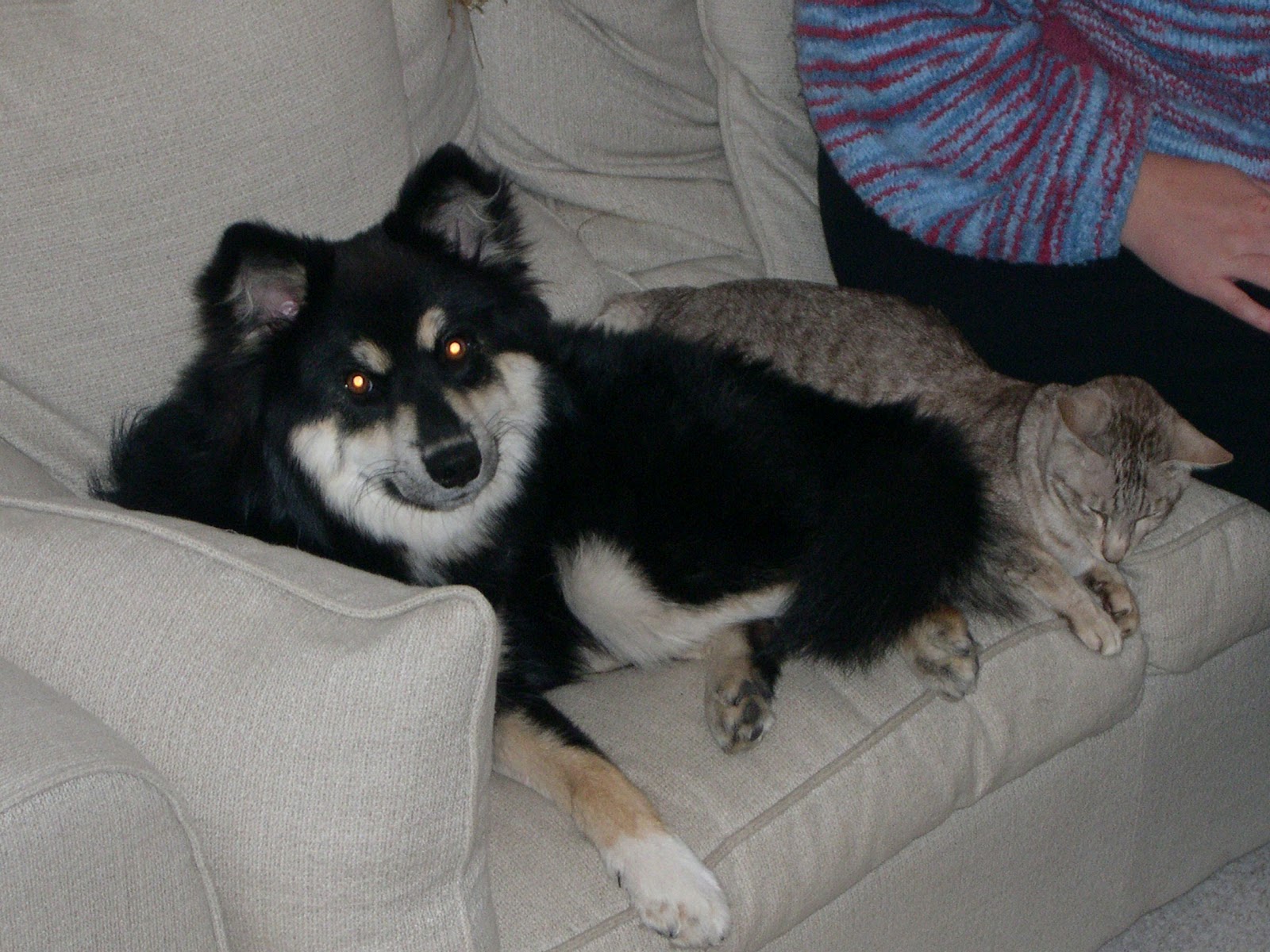
Kallio illustrating another excellent use for the "Off" command.  Obviously he thinks anything the cat can do is fair game.


There are lots of things you can and should teach your dog, but I've reached the end of my list of absolute essentials.  Hmmm, maybe I should have kept point one from the first list as separate entries: sit, down, stay. That would have nicely filled out 2 sets of 5.

What has been the best or most important thing you ever taught your dog?

Tuesday, 14 February 2012

one last Keksi update

During the 2 weeks that Keksi was back at home, Daniel was joking with me that she looked as though she was carrying many puppies.  Many.  Eleven, he said.

Now, before you get excited, he doesn't actually know anything, so his little joke was just that - a little joke.  (To be precise, he does actually know stuff.  Lots of stuff.  And much knowledge.  He is a scientist with a PhD, after all.  However, his knowledge does not extend to how many puppies Keksi might or might not be carrying.)

But... just look at this belly.


Pretty impressive, no?


And, for comparison purposes, here she is from the same-ish angle as the previous belly updates.


This is what Neka looked like at a similar stage of development when she was carrying the current record-holding litter of 9.


So, do I think that Keksi is carrying a litter of 9?  No, of course not... well, maybe.

And, on that note, here's the poll.  It's just for fun, there are no prizes for right answers, but you can participate at the top right-hand corner of the blog.  The question is this:  how many puppies will Keksi have?  The poll will run until the puppies are born - about a week.

And do not ask me why the girls are wearing leads in those photos.  After all, with those bellies they can barely walk - where exactly did we think they were going to run off to?


Monday, 13 February 2012

mama has arrived

Yesterday we had a quick trip to our usual meeting point, Leigh Woods, to hook up with Daniel & Jim, have a little stroll in the mud, I mean, woods, and bring Keksi home for the duration of her pregnancy.

Kuura was looking gorgeous after his big moult.  He's still very fluffy at each end - around his neck ruff, trousers and tail, although he's lost most of his undercoat now.  Here he is back in the car which is showing the muddy evidence of our walk. 


And Keksi?  Well, she is looking ready to burst, frankly.  No wonder Daniel was having nightmares about her giving birth before making it to Devon.  Oh, she's big.  Really big.  The puppies are due to arrive in approximately a week.  Tomorrow an update on The Belly and a little poll on the size of the litter.  I'm saying more than 5.  Definitely more than 5. 


Friday, 10 February 2012

product review - Yumega oil supplement

Yumega Essential Omega Oil for Your Dog's Coat and Skin

Available In:  250 ml bottle

Price:  £10.69 plus delivery.
You can find it slightly cheaper online but best value is to buy 6 bottles for £59.25 or get a deal at a large dog show like Crufts.

Ingredients:   Golden flax oil, starflower oil, vitamin E

Manufacturer:  Lintbells

Website:  http://www.lintbells.com

What it Claims:

From Lintbells website:
"YUMEGA Dog is a unique blend of natural Omega 3 & 6 oils from coldpressed golden flax and starflower, proven to generally improve dog health, coats and skin.

YUMEGA is proven to:
  • Reduce excessive dog moulting
  • Improve dry, flaky skin
  • Develop the perfect coat
Trusted and recommended by thousands of breeders and vets, Yumega Dog is easy to use and will improve your dog's skin and coat condition in as little as 3-6 weeks."

How it Works:

Flax seeds and starflower (borage) oil are the best known sources of Omega-6, an essential fatty acid which has proven benefits for skin and hair, amongst other health benefits.  The primary source of Omega-3 is oily fish, but it is also found in flax seeds.

What I Did:

On the advice of a friend who had great success with Yumega, I bought 6 bottles to use on my 3 dogs.  It is administered in their food and introduced slowly at the rate of half a normal dose for the first week.  In the end I didn't give any to our Akita, Annie, as she was already on various oil supplements for her joints, so I used 2-and-a-bit bottles in total on 2 dogs over a period of a few weeks after they had finished moulting.    For a medium-sized dog, the dosage is 5 - 7.5 ml per day, so one bottle approximately equals a month's supply for one Finnish Lapphund.

Did It Work?

I didn't actually see an enormous difference after using Yumega.  Their coats were slightly more shiny, but there was no change in Neka's itchy skin condition.  As my dogs get a varied diet rich in fish oil, anyway, it's possible they were already getting much of the benefit that Yumega offers.  There are certainly other Lapphund owners who swear by the product for maintaining their dogs' coats.  The reviews found online are a similarly mixed bag.  The benefits seen probably depend on how much Omega-3 & 6 your dog gets otherwise. 

I stopped using the product and gave the remaining bottles away to very grateful friends and raffles.

Summary
Pros - easy to adminster
Cons - a bit pricey at more than £10 per month per dog

Woof Rating:  3 out of 5


Thursday, 9 February 2012

five things you should teach your dog

Even if you have no intention of ever attending a formal obedience competition, all dogs should be enrolled in obedience classes when they are young, at least.  Training your dog is good for you both.  Quite apart from the socialisation that your dog receives at such classes, the training increases the bond between the two of you, and it gets your dog in the frame of mind for doing as he's told.  If you're inexperienced at training, you learn how to do it, and your dog gets to learn all the basics that he needs in order to be a responsible member of canine and human society.

And even if you have never attended any kind of dog training class, there are some things every dog should do on command.  Here are five of them.

1.  Your dog should sit, lie down and wait/stay on command.  These are basic doggie manners that you will use again and again. The more impatient and fidgety your dog, the more important it is that he will respond to the basics.


Keskiyo learning to stand on command.


2.  Every dog should have a reliable recall.  Now, I can actually hear the legions of Finnish Lapphund owners howling with mirth as I type this.  You see, Lapphunds are renown for finding every person, dog, squirrell (twig, blade of grass, etc, etc) so absolutely captivating that they will leave you waiting until they are good and ready to come back.  However, if you ever plan to allow your dog to run freely off-lead, then you must have at least some prospect of getting him to come back to you when you call him.  If you are lucky enough to have a greedy, food-motivated dog, then the recall is much easier to train - and much more likely to work in practice, even when there are extreme distractions involved.

3.  Every dog is likely to have an injury during its lifetime, whether it is a major one requiring vets and surgery or just a minor one like a skin graze or splinter in the paw.  If you - or the vet - are going to be able to find the problem safely and without frightening or further injuring your dog, then he needs to be accustomed to being examined.  You should therefore teach your dog to willingly submit to being gently handled from head to toe, in his ears, nose, eyes, mouth, belly, paws, between the toes and the sensitive bits under the tail.  You should teach him to accept such intrusions while he is standing, while he is sitting, while he is lying down and to expose his belly for examination too.

4.  The instant down is one that I credit with saving Neka's life - perhaps more than once.  The ability to get your dog to immediately stop what he's doing, drop to the ground and stay there is a vital skill to keeping your dog safe.  It will also possibly keep the local squirrell and cat population safe too, as the very best instant down will even stop your dog in mid-chase.

5.  Finally, one great skill for dogs is to have what is known as a soft mouth.  This is also known as bite inhibition.  Dogs with good bite inhibition will take things from fingers without grabbing and they will hold things in their mouth without biting down hard.  It's this capability that means your dog will instantly let go when his teeth encounter human skin.  In playing with people, he won't accidentally bite, and in a scuffle with another dog it really will be all noise and fur with no actual damage done.  My favorite places to go for all things training, including soft mouth, are Gwen Bailey's Perfect Puppy and and Ian Dunbar.  Online, you can get some good Dunbar advice in a free pdf from Dogstar Daily.


 Quite apart from anything else, good training ensures you can occasionally get your group of dogs together for a photo opportunity.
 L-R: Keksi, Keskiyo, Neka (back), Maija

Already I can think of at least 2 more essential things that every dog should know.  I feel a five more things you should teach your dog post coming on...

Wednesday, 8 February 2012

pup tip - start as you mean to go on

Right from the first day in his new home, a puppy should be exposed to the normal daily routine he will be expected to abide by for the future.  I always recommend that people take some time off work when they bring their new puppy home.  You need time to sort out the house training, do some bonding, spend a few hours puppy-worshipping, get him sleeping all night, do lots of short and fun training sessions, and prepare your puppy to spend time alone.

First Night

A puppy's first night or two away from his mum & littermates will probably be absolutely awful for him - and for his new owners.  He will cry and howl and be quite pitiful.  There are other methods, but I recommend the tough love approach - keep him awake in the evening so that he's really tired, put him to bed with a few bits of food and some safe toys, and then turn out the lights and go to bed.  And put in your earplugs.  And don't return to him no matter how heartbreaking his cries.


Ukko at home in his crate during his first week home.


Because you know what happens if you return to him and give in, right?  Yes.  He will throw a tantrum everytime he wants something, secure in the knowledge that if he barks and howls for long enough, he will eventually get his own way.  And he will do the same thing every single night when he goes to bed...

It usually only takes a couple of nights for him to give up and go to sleep.  Then once he is happy sleeping at night, if he then wakes up and calls, he almost certainly needs to wee and/or poo.  In the interest of his house training, it's then a good idea to drag yourself out of bed and take him out to do his business so he's not forced to do it in his sleeping area.  He would rather not soil his bed, but if he has no choice, then he will do so and will thereby learn that it is acceptable to do so in the future.

Alone Time

The other routine your new puppy must learn is to spend time alone.  Again, being alone will be all new to him.  Each of my puppies gets to spend a few minutes alone as part of my socialisation programme, but that's very different from learning to stay at home while you go to work for a couple of hours.

So, whatever you do, don't wait until the day before you go back to work to start worrying about leaving him.  Start the alone routine straightaway on his first morning with you.  You take him out for his morning ablutions, give him his breakfast, take him out for more wees & poos, do some playing, more house training, and then when he's tired, put him in his crate with some toys and leave him alone.  Get him started on what is going to be his normal morning routine.

Even if you don't work and you plan to spend most of your time with the puppy, he will still need to learn to be left alone, so it's a worthwhile exercise regardless.

Furniture, Chewing, Upstairs

Finally, you need to decide what your adult dog is going to be allowed to do and what he is not going to be allowed to do and then apply those rules to the tiny, adorable puppy.  If you don't want your big galoot of a wet dog to lie on the sofa, then don't let the irresistible 8-week-old ball of fluff on the sofa either.


Neka wasn't allowed on the furniture, so she would sleep with her head on our feet.  So cute!


And then we decided that having the animals on the furniture was actually ok with us.  Just as well.


If you don't want your dog jumping on people, then don't let the tiny puppy jump up either.  The same goes for letting the tiny puppy chew your fingers.  At first it's quite cute.  Then it really isn't.   In fact, the same goes for chewing anything.  Decide what your puppy is allowed to chew, which rooms he is allowed to use, whether or not he is permitted upstairs, and then enforce the rules rigidly.  Rigidly.  Don't make exceptions - ever.

Why not?  Because the important thing with all matters of successful dog training and raising a well-mannered, well-behaved adult dog is consistency.  Do the same thing everytime and demand the same behaviour of your dog all the time and at all occasions.  The bottom line is this: your dog will do whatever you teach him to do, and whatever you allow him to do.  If you allow him to do something once, he will think he can do it forever.  So be careful to only ever let your puppy learn what you want your adult dog to be.  

Sounds, easy, doesn't it.  Uh huh.

Tuesday, 7 February 2012

Keksi update

Daniel reports that Keksi is enjoying her pregnancy, and is her normal happy, chilled self.  Here is the Lady of the Growing Belly relaxing ... in front of the fire?  Surely it wasn't lit.  At any rate, I'd say she's blooming.


She has been on slightly more food for a week now and has just started daily worming so that the puppies have the best possible start.  In a week she will come back down to us to settle in and have her puppies and she will stay until they are weaned.

I've been busy compiling all the stuff we'll be needing like the disposable whelping box, rubber gloves, round-tipped surgical scissors and clean towels.  And newspapers?  You may recall that I ran out of them last time and had to send out requests to my neighbours for emergency supplies.  This time I've got plenty.  I'm quite sure it will be plenty.  Well, plenty for a normal sized litter, anyway.  Daniel is threatening me with 11, though, based on the rapidly expanding girth.  Shhh - don't even think it!

Then there is the small matter of cleaning out the puppy room - a mammoth chore each and every time.

In the meantime, I've been told that Keksi performed another expert and impressive bin raid and that Daniel had a hard time retrieving all the bits of ripped up cardboard before she scooped them up.  Between the wood and the cardboard, I'm beginning to wonder if she's planning to have a litter of beaver pups. 

Not long now and we'll find out.  Tiny pointed tails?  Or tiny flat tails?

You get an idea of her changing shape from the photo above, but here is a belly update too.


Monday, 6 February 2012

rain or shine

Regardless of the weather, your dog needs exercise.  If you are lucky enough to have a Finnish Lapphund, then you will find yourself walking in all sorts of disgusting weather.  Lappies were bred to work and so they have a lot of energy.  That energy needs to be channelled everyday and I have found that the worse the weather, the better the Lapphunds like it.  Heavy rain?  They scoff at all sorts of rain, sleet and even hail.  Wind blowing trees horizontal?  They love that!  In fact, there is little so likely to bring the puppy out in my dogs than a gale force wind blowing through their coats and up their tails.

Apart, perhaps, from snow.  Lots of dogs love the snow, and Lapphunds - appropriately - seem to have a love of snow bred into their genes.  There were lots of happy Lappies around the UK over the weekend when there was a large amount of snow dumped over a 24-hour period.  Here in Devon we had a tiny sprinkle but then the rain moved in.


Neka enjoying a rare Devon snowfall last winter


Photo: Wendy H Gilmour


Karhu coming over all puppy-ish in the snow with his stick


And if the weather is just too disgusting for much of a walk, then your dog will need entertainment and exercise more than ever.  Here, from Dogster are some ways to keep your dog happy and occupied when you can't go outside.  Or even if you can, because these games are great fun for you and your dog.

Friday, 3 February 2012

grooming

All dogs like need a good brushing from time to time.  It helps if your dog also likes to be groomed and you can help this along by gently brushing your puppy a little everyday to get him accustomed to it.  With perseverence and a smidgen of luck your dog will grow to enjoy quiet time alone with you to be groomed.

Some dogs need more grooming than others.  You might think that a Lapphund, with its long, thick coat, would need agonising hours of brushing, but not so!  Their coats are surprisingly easy to maintain - a bath once a year or so (providing they don't roll in something disgustingly smelly, that is), and a good brushing through the thick undercoat down to the skin once a week.  Ish.

Young Lappies and dogs with softer coats will need more brushing rather than less.  The soft fur around the ears and legs will need regular combing to prevent matting.  As the dog matures, the coat becomes coarser and easier to maintain.  When they get muddy, just wait for them to dry and the dirt simply falls off.  Ideally somewhere easy to clean up rather than the sofa or your prized antique Turkish rug.

Lapphunds don't lose much hair in between moults, but when they do moult once or twice a year, then it can make quite a mess.  Your Lappy puppy's first big moult is an experience like no other you will have had.  The undercoat comes out in - literally - bagfuls, yet there always seems to be more to be brushed out tomorrow.


Daniel with 13-month-old Kuura after one good brushing session during the boy's 1st big moult.  You can see from his woolly coat that there is plenty more to come.


I generally advocate the use of 2 or 3 specific grooming tools.  However, after using the same things for several years, I'm now in the market for a couple of new dog brushes, so watch this space for future product reviews.

No discussion of grooming would be complete without mention of trimming the nails.  Oh, the trauma!  Oh, the drama!  It is an event in itself and so warrants a blog post to itself too.

But, until then, the helpful folks at Dummies.com have produced this handy guide to brushing a dog.  Keep in mind that an adult Lapphund will have a very thick, long coat and you will need to brush it in very small sections to ensure you don't miss any.


Thursday, 2 February 2012

how to take good dog pictures

Now you know I know I need this lesson.  Animals are tough to capture well in photos. Even the people who do it well admit to taking hundreds to get a few good ones. I take hundreds to get, maybe, one good one.  If I have a bit of luck too.

It helps to have a good camera so that you can maximise the lighting, detail and the greater shutter speed of the new DSLRs.  I have a good camera.  However, I have yet to acquaint myself with the finer points of its operation.  I still use it like a point-and-shoot.  But, y'know, it's good for that too.

Nylabone on their blog have produced this handy guide to taking good pictures of dogs.  There is some great advice in there.  There is also some advertising in there (our great Nylabone products, etc).  However, if you don't mind the advertising - and I don't because I quite like Nylabone products so I'm happy to do a bit of product promotion on their behalf - then it's well worth a read if you're struggling with your canine model.

It's also well worth a read if you're soon to get a new puppy and that puppy's breeder will be waiting eagerly for photo updates.  Just sayin'.

The best advice I can offer for getting photos of dogs is to have friends who are better acquainted with their cameras than you are and who take great photos that you can use.


Thank you to James Henson for this great photo of Maija, puppy-who-was-never-still.


This one is courtesy of Joanne Ross.
L-R: Rauhan, Sulo, Tarkka, Aurinko


This is one of the best photos ever taken of Keskiyo, captured by Jay with our then-brand-new DSLR camera.  But I'm not going to say it was a lucky shot.

Wednesday, 1 February 2012

don't feed the dog

Of course I don't mean actually don't feed a dog.

There are some things that dogs should only ever have as occasional treats and there are some things that dogs should never have.  The sort of thing that falls into my category of "occasional treats" includes most human food and the Pedigree Jumbone / Dentastix / tripe sticks, etc, sort of canine consumables.  By "occasional"  I mean no more than once a week.  Yes, I'm strict, I know.  And when they do get a Dentastix or Jumbone (both of which they love), they only get half of one each.  And that's plenty.

As a result of this my dogs are not fat.  In fact, they are lean and healthy, even if they do hate me.  Perhaps hate is a strong word.  Perhaps they just resent living here instead of somewhere with a softer touch for an owner where they might get leftover roast lunch on Sundays, bull's pizzle every morning and a ham sandwich now & again.  No such luck in this house!


Usko, age 3.5 months, enjoying a very safe chew - a nylon bone with an edible fake marrow inside that dogs love to eat. 


Amongst my list of things that dogs should never have are:

Chocolate - you know that human chocolate is toxic to dogs, right?  Dark chocolate or baking chocolate is the worst.  Don't let them have it and don't leave it where they can get it.  There is a doggie version of chocolate that is safe, but my poor maligned dogs don't even get that.  Not because it's poisonous, because it's not, but just because of the horrid ingredients.  I'd rather give them a juicy raw bone.

Citrus fruit - Lemons, limes, orange, grapefruit and their juice are all very bad for dogs as their stomach cannot deal with the citric acid.

Grapes & raisins - Both highly poisonous for dogs and, worst case scenario, can cause kidney damage.

Alcohol - Don't think it's funny or cute to let your dog drink beer.  Hops can cause seizures and any kind of alcohol can even kill a dog.

Seeds & pits from various fruits - like apricots, cherries, apples, peaches.

Nuts - dogs can choke on nuts; macadamia and walnuts can both cause awful illness.


Photo:  Joanne Ross


Tarkka enjoying every Lapphund's favorite treat - a snowball!


Tuesday, 31 January 2012

Weston beach walk

On Sunday we met a bunch of old friends and new friends-to-be with a rather large group of Lappies for a walk at Weston-Super-Mare again.  I have to say that I'm pretty unimpressed with the council for charging such extortionate parking fees.  Even in the middle of the winter the minimum charge was £2.50 and when we went there in November it was twice that.  So I don't think we'll be troubling their lovely beach again with our half dozen cars and twice the number of dogs.  There are lots of nice places to walk that don't cost the earth in parking.

The weather was incredibly kind to us, if chilly - the forecast was for cold & wet but we only got the cold.  Phew!  Even those who were threatened to be homebound by snow managed to make it.

Thanks to Mark Treasure for the great photos, as always.  Most of these are his, the poor phone shots 1st & last are mine, as usual.  We didn't manage to remember to get a group shot of everyone there, but if my memory serves correctly, we had 12 Finnish Lapphunds and about twice that in people.


That sign beyond which everyone is walking?  It says something like: "DANGER beyond this point."
Yup.


Much running & playing.
L-R: Kaija, Miika, Kesa, Taika
It's anyone's guess who is running to catch up in the distance, but my guess is Minna.  She is not one to miss out on a good game of chase.


Case in point:
L-R: Minna, Kaija, Taika, Miika


Even Keksi did a little bit of running, but mainly she stayed close to the humans' legs (and pockets full of treats).
L-R:  Keskiyo, Keksi


Neka, the eldest in attendance, had a wonderful time, racing around like a dog half her age.


And this tells the story of later that evening.  Evidence of a very good day.


Monday, 30 January 2012

pup tip - 1st day & night

When you first bring your puppy home, everybody is going to be excited about the new family member and all your friends and neighbours will want to visit.  Resist the urge to show off your puppy straight away.  Plan for your puppy's first experiences of his new home to be quiet and calm.  Give him the opportunity to get to know you and your house, where his things are and what his new routine is going to be without the comfort and security of his mother and siblings.

Keep in mind that it's a big, new, scary world for your puppy; ease him into it.  Let him find his feet and feel at home before bringing in the well-wishers and puppy-cuddlers.  Once he is feeling secure and at home, then bring on the visitors. Keep numbers down to 2 or 3 at a time, though, so that he is not overwhelmed.

While he is being visited and fussed, be sure not to neglect his toilet training needs and always allow him to get sufficient sleep.  He'll be excited and enjoying the fuss, but it's up to you - the parent, as it were! - to enforce quiet time.


Neka at 8 weeks old, a couple of days after arriving.

Friday, 27 January 2012

five ways to help your dog lose weight

While recently on the subject of overweight dogs, and assuming your dog's girth is not expanding due to a litter of puppies growing in there, here are some tips for helping your pooch to shed those unhealthy kgs.

Taito looking a bit pudgy

1.   Before embarking on a drastic weight-loss programme, visit your vet.  Find out what a reasonable and healthy weight is for your dog and make sure your dog is physically able to exercise safely. 

2.  Start and maintain a regular exercise routine. If your dog is unfit, start small with short, easy walks and build it up gradually.  Aim to get your dog on at least one long walk every day. If you have time for two walks, or more, so much the better.  Don't let your dog wander along sniffing the ground - put him on a lead and keep up a brisk pace.

3.  Look very carefully at what you're feeding your dog and then cut out the treats.   All of them.  For training, use pieces of kibble taken from your dog's meals (not in addition to his meals).  If you must give a treat, give raw vegetables instead of unhealthy high-fat, high-salt store-bought treats.  If your dog won't eat raw veggies, then he is not hungry!  Give your dog big meaty bones fresh from the butcher - they are very satisfying.

4.  Change your dog food.  Get rid of the standard brands you can buy in supermarkets.  They are full of unhealthy additives and preservatives and generally have too much fat and sometimes even non-edible rubbish! Instead, replace them with high-quality premium dog foods such as those sold in pet shops or veterinary surgeries.  

5.  Give your dog two or more small meals a day instead of one big one.  To slow him down, consider one of the bowls specially designed for dogs who eat too fast.  Feed your dog less than the amount recommended on the dog food bag - the aim of those guidelines is to sell more dog food!  If your dog is still not losing weight, decrease the amount in his meals by 10%.  Add a few raw vegetables to your dog's meals to bulk them up without the extra calories.

Taito looking perfectly fit
 For more reading about helping your dog to lose weight, here is an interesting article from the Whole Dog Journal with lots of good advice about what to feed and how.

Thursday, 26 January 2012

belly update

A little over a week ago I was watching Keksi's belly for changes.  There was no sign at all just 7 days ago that she was in whelp.  And then, so suddenly, she started to look a bit rounder, just a couple of days before her scan.  Now, at day 36/37 after mating, there is a definite swelling of the belly.


The slightly heavier waistline hasn't yet slowed her down on her walks, though.  Today she was certainly giving Maija, the original speed freak, a run for her money... so to speak.

Wednesday, 25 January 2012

don't shoot the dog

I've borrowed the title of Karen Pryor's excellent training book in response to the hysterical frenzy whipped up by the public, media and politicans whenever there is a tragedy involving a dog and a person.  This week a child was attacked by a dog and, as always, it has led to cries for banning certain dog breeds.

There are a couple of reasons I didn't watch the BBC documentary "Death Row Dogs" last night.  I never watch these things because I already have more than enough awful images stuck in my head that I wish I could scratch out.  And I also don't watch them because I usually get so angry and frustrated at the sensationalism or the ignorance or the one-sidedness that I start yelling at the television and upsetting my own dogs.  And, really, none of us need that - with 4 dogs in the house we generally have more than enough opportunity for noise.

But on this subject I'm with Beverley Cuddy, Editor of Dogs Today magazine.  You can read her excellent blog on this subject here.

In the meantime I leave you with an old photo of Neka, aged 11 months, playing with Annie, who was our very own "dangerous dog" Akita. A more gentle, loving and dignified dog you could never hope to meet.  Does she look scary here playing?  You bet she does.  Was she completely reliable around all people, children included?  Yes, to our knowledge, she certainly was.  Would we ever have left her (or any of our dogs) alone with small children, as Beverley discusses in her blog?  No.  We definitely would never have done that.


Rauhan & Pippa illustrate the wonderful relationship between dogs & children when carefully supervised

Tuesday, 24 January 2012

and then...

Yesterday's post was written last week.  What can I tell you, the commitment to post 5 days a week requires advance planning (kinda like that "spontaneity" I was referring to earlier).

Anyway, shortly after writing that post I was looking closely at Keksi's ever-expanding waistline and thinking to myself that I must be feeding her too much.  Then I said to one or two people that if I had to guess, I'd guess yes.

And so on Sunday up the A303 Keksi & I went for her to be scanned by the very helpful Kath.  And it's confirmed:  we're having puppies!  Cue much whooping & dancing.  Well, one whoop and a little shuffle, anyway.  That's about all the energy I can muster, I'm afraid, regardless of how good the news.  Jay was away for a week & I've been taking care of 4 dogs on my own with not enough sleep or time to fit everything in, so there was actually very little in the way of dancing, in truth.

The scan says "five, or at least five", which was the same prognosis as for Keksi's last litter of seven.  So the new waiting begins to see how many will arrive.  It could actually be fewer than 5 because a bitch can re-absorb foetuses if they are not viable.  But I'm remaining confident of the "at least five". 

This is what I'm looking foward to in about a month's time - content mum & babies taken 24 hours after their birth last time:

Keksi with the Persikka litter, 1 day old

Monday, 23 January 2012

signs 2

A few days ago I was looking for signs that Keksi might be pregnant.   The very first sign of pregnancy is often an uncharacteric tendency to slow right down on walks.  I saw this with both of Neka's litters, especially the second litter of nine puppies.  A couple of weeks after mating, Neka made a dramatic transformation from a running, zooming, light-on-her-feet dasher to a by-my-ankle plodder.  The plodding lasted only a couple of days, and I only half-noticed it because the weather was warm and so a bit of slowing wasn't really remarkable.

So, did Keksi display any of this deceleration?  Well... the only answer I have to offer is, I don't know.  Sorry.  She wasn't with me at the time and, frankly, with Keksi anything goes.  Daniel reports that on walks she is constantly running around, chasing squirrells, disappearing off and speeding back.  In my experience, Keksi is much more of a natural plodder, sticking close by and rarely deigning to break a sweat.    These days, enjoying her newly svelte shape, she does actually pick up speed a bit and give the squirrells a worry or two, even when she's walking with me.

But, then, all the Lappies love to engage in a bit of squirrell bothering.  Here is Keskiyo looking rather smug at having chased a poor critter up a tree.  And if it had been Neka, the photo would have been little more than a blur of Lapphund on 2 legs, mouth wide open as she variously tried to bark the squirrell back down to the ground or, alternatively, to climb up there and get it for herself.


I ask you, does this look like a dog who is slowing down?


That's right, no, it does not.  However, I am consoling myself with the fact that the time for slowing down is long past.  

And if you're wondering why poor old Neka is on her lead in this video it's because she knows this walk so well that she feels the need to disappear for way too many minutes at a time in search of new adventure whenever we go there.  And we go there often.


Friday, 20 January 2012

five things that are not so great about having a dog

1.  You are often carrying around a bag of poo.

2.  All your pockets are stained with dog treats.  And your walls/furniture/car with mud.

3.  Much of your wardrobe is chosen on the basis of what hides dog hair most effectively.

4.  You can forget disappearing off to Paris for a spontaneous romantic break - spontaneity
     requires advance planning.

5.  You are forced to get fresh air & exercise everyday whether you want it or not
     and regardless of the weather.

    Wet, muddy Kesä having a drink


      Thursday, 19 January 2012

      trick - sit

      Here's another first of what I hope will be a regular feature - how to teach a new trick.  However, I'm starting small with the basics - it's not a trick, as such, but the most basic thing to teach your dog is to sit on command.  I'll get on to the complicated stuff in due course.  Like, in the case of young Lapphunds, walking nicely on a lead, for example.  Or, say, for another example, the recall.

      But, for now the sit.

      Aim:         Get your dog's bum on the floor and his nose pointing toward your face, giving you attention.

      Use For:  Everything!  Sitting is the most basic of doggie manners.  Use it when he is greeting someone, when he is at the vet, when he is at the kerb waiting to cross the road.  When you need some control.  Sit, sit, sit.  SIT.

      Start with a pocketful of tiny treats that your dog loves.  Treats should be about the size of the tip of your little finger.  Small.  And easy to eat.

      1.  Hold a treat next to your dog's nose (don't let him grab it, obviously...)

      2.  Slowly move the treat back towards the top of the dog's head, between the ears.
           Don't lift your hand too high - keep it low and near the dog's nose.  The aim is to get his nose to
           follow the treat - i.e. pointing up.

      3.  As your dog's nose points up, his back legs will bend and his bottom will head towards the floor.
           As soon as his bottom touches the floor, say the word "Sit".  Immediately give the treat and
           praise him enthusiastically with the words "good sit" and/or "good dog".

      Perhaps I'm too ambitious, but I've made a little film to illustrate the method.  Making a film fit for public consumption?  Difficult.  Specialist, even.  Filming animals?  Very difficult.  Very.  Filming animals with no help?  Even harder than that.  Filming animals with no help and with a jealous canine audience barking & kicking up a fuss at the sidelines...?  So you shall see.  Don't judge me too harshly, my filming technique can only improve!


      Of course, Keskiyo already knows how to sit, so a new puppy will take a bit longer to get the hang of it than Keskiyo does in this film. 

      If it's Not Working 

      If your dog's nose is following your hand but his back legs are not bending, then you are holding the treat up too high.  Keep your hand close to the dog's nose during the whole exercise. 

      If he keeps scooting backwards rather than bending his legs, don't give the treat and don't react.  Just start again.  Don't get frustrated, just be calm.  If you find yourself getting frustrated at any point when training your dog, stop and try again later.

      Don'ts:  Don't get angry or impatient.  Don't yell or use a harsh voice.  Don't push your dog's bottom down.

      Tips for Success:  Take your time.  Be patient.   Be quick to give treats and enthusiastic praise.  Be generous with the praise and petting.  Always reward well while your dog is still learning.


      Wednesday, 18 January 2012

      book review - control unleashed*

      Control Unleashed: Creating a Focused and Confident Dog
      (c/o Clean Run Productions)

      Author:  Leslie McDevitt, MLA, CDBC, CPDT
      Publisher:  Clean Run Productions
      ISBN:   978-1-892694-17-1
      Pages:  226
      Price:  £17.50

      Classic Quote

      “Even if a student and her dog do not perform an exercise perfectly, as long as the dog is looking happy and engaged with his handler, I count that as a win.”

      About the Author

      Leslie McDevitt is a certified dog behaviour consultant and pet dog trainer in Philadelphia, MA, USA.  Her behaviour-based articles have been published in the agility periodical, Clean Run, and in Dog Fancy.

      Structure

      McDevitt is a trainer of agility and often found dogs in her agility classes who were unprepared for working within such a stimulating environment. For reactive dogs who had difficulty concentrating in the agility class setup, she devised a seven-week behaviour modification course as a pre-requisite to agility training. She called that course Control Unleashed (CU), and this book outlines the content of the CU course in week-by-week exercises.

      The book is studded with true stories and case studies from her CU experiences and threaded throughout is the story of McDevitt’s progress with her own dog, Snap, to whom the book is dedicated.

      Control Unleashed is aimed at:
      1. Students of dog sports or the companion dog owner whose dog has difficulty concentrating or working off lead near other dogs or in exciting situations.
      2. The experienced agility or obedience instructor who reads dogs well and wants to get a handle on dealing with the disruptive dogs in class.
      Difficulty concentrating in exciting situations? That sounds like a Lapphund or two to me! I couldn’t wait to get my hands on the book, which I ordered from the US, but it is now available in the UK. 


      What is Great About This Book

      First of all, it’s a relief to find a dog book with a new approach that really works. It’s a mile from the standard unhelpful advice which runs along the lines of:  keep your dog’s attention on you at all times to avoid him focusing elsewhere and then when your dog’s attention does wander, it’s your fault for not being “interesting” enough.

      Instead, McDevitt has worked out strategies and games for building up dogs’ confidence, techniques for keeping their excitement at a manageable level, and methods to train your dog to want to focus on you, not because you say so but because he’s no longer distracted by outside stimuli (like other dogs, for example) and because it is a fun game for him to play. It all adds up to a strategy for helping dogs be comfortable around other dogs and other stimuli while remaining focused on his handler and ready to learn.

      The CU course is for dogs who cannot think or control their impulses when they’re excited, who need to learn to relax and focus in the presence of their triggers without becoming reactive, and who need to learn to work off-lead in stimulating situations without getting distracted. CU is not an agility course and it is not an obedience course. It’s a behaviour modification course based on the principles of desensitisation and counter-conditioning.

      Each class chapter starts with a list of clear aims and new exercises that will be introduced in that class, so you know where you’re headed as you work your way through. The description of each exercise is clear, detailed and mainly easy to follow with lots of helpful advice for what to do if things are going wrong. The case studies are well chosen to illuminate the lessons being taught, and there are plenty of photos that illustrate the points extremely well, even if they are a little small.


      The best thing about this book is that the strategies really work! Well, those that I’ve tried thus far, anyway, have been amazingly successful and in a shockingly short period of time. So far, my favourite game is “Look at That!” which is designed to get your dog to glance at his trigger (i.e. scary other dog, for example), then revert his attention immediately back to his handler for a treat. This takes the stress out of looking at a formerly scary thing and turns it into a game that will earn the dog treats. It turns looking at the scary thing into a cue to revert his attention to his handler. Even better, it does so while allowing the dog to check out his environment and reassure himself that there is nothing around him he needs to be worrying about.

      I took my reactive, noisy Lapphund, Keskiyö out with clicker and treats in hand and as soon as he focused on another dog and started to bark, I said “Look!” in a suitably pleasant voice and clicked straight away. He knows what a click means, and he turned to me immediately with a confused look on his face as if to say, “You mean you’re going to reward me for barking at that dog? You usually tell me off for barking at other dogs.”  We started playing the "Look!" game for clicks and treats with every exciting thing he would normally zoom in on.  After only two walks he had already begun to stop stressing and start concentrating on the game. 

      The trick, of course, is to manage the situation so that the “trigger” doesn’t get too close. But with my dog’s triggers far enough away to keep him under threshold, the results were fast and dramatic.

      What’s Not So Great

      Unusually for me, I really don’t want to criticise anything about this book.  I value its content at least as much as, or more than, any other dog training / behaviour book I’ve ever read. However, there are a lot of issues with the book that the reader will need to be aware of.

      First of all, Control Unleashed uses a great deal of jargon – terms from psychology like “reframing” or “conditioned emotional response” and from the world of dog sports, such as “contacts”, “two-on-two-off” and “circle work”. Once you get used to this, it’s fine, but it’s distracting and a bit confusing at first if you’re unfamiliar with the terms.

      In addition, although it is not necessary to use clicker training in order to follow the exercises in this book, the descriptions do utilise this type of terminology and procedures. For this reason, the reader would be well advised to brush up on clicker training before tackling Control Unleashed.

      My only real complaint with the content of the book is that there are a couple of instances of principles being introduced or mentioned but never fully described or explained. For example, McDevitt puts great emphasis on calming anxious dogs by using massage such as Tellington Touch (TTouch) or a technique called the Protocol for Relaxation. TTouch is given a one-line description with references for further reading. The Protocol for Relaxation, developed by Dr Karen Overall, is introduced in two paragraphs, giving just enough information to make you realise that it will take another whole course or book to learn it separately. Yet it is presented as one of the first crucial tools to the CU approach.

      Finally, the major goal of the CU course is to make the handler more aware of her dog, his needs, his triggers, thresholds and responses and to find the right balance of stimulation for her particular dog. This is a highly complex topic with individual requirements and trying to get that from a book is difficult. This is specialist material based on reading your dog to tailor the exercises to his particular requirements. Anyone who is less skilled at reading their dog will struggle with getting the balance right in attempting the exercises.

      I found that the exercises and descriptions became more and more complex and difficult to follow as the book went on. Furthermore, some of the more advanced and complicated exercises that give the final touches to bomb-proofing the dog would be difficult to apply in the “real world” outside the class situation.

      These problems are not a fault of the book, as such. Rather, they arise as a result of trying to lift a step-by-step book directly out of a fluid and changeable class structure which is managed by an expert in dog training and behaviour.

      The solution, of course, would be to take a Control Unleashed course instead of reading the book – and I very much wish I had the opportunity to do so!

      Worth Reading?

      Definitely.  In fact, I think a Control Unleashed type course should be mandatory for most Lappy owners! After all, how many of us haven’t struggled with the over-zealous, barking Lapphund zooming away to say hello instead of paying attention to us? However, in the absence of any CU courses in the UK – or certainly in my neck of the woods – then this book is a must for everyone with a distractable dog. 

      Summary

      Round Up:  Excellent plan for teaching control to reactive dogs
      Best For:  Experienced dog handlers
      Woofs:  4/5

       *This is an edited version of a review I originally wrote for the Dec 2009 edition of Lappy Tails, the newsletter of the Southern Finnish Lapphund Society.  Reviews written specifically for this blog will be shorter & more consise.  Probably. 
       

      Tuesday, 17 January 2012

      weight watching

      In spite of their great energy, Lapphunds often have a weight problem.  Perhaps it's the fact that they are very greedy eaters.  Greeder eaters are easier to train, but more difficult to keep healthy, weight-wise.  I've had 1 greedy eater and 1 fussy eater - I never had to worry about the weight of the fussy eater - in fact, it was a struggle to keep him looking in good condition because he was so persnicketty.

      Neka, the greedy eater, is kept slim & fit by 2 plain meals a day and a minimum of treats (often raw veggies rather than pieces of sausage).

      In Neka's first litter she gave birth to 7 chips off the old block.  Greedy little devils every one.  And weight watchers, every one.  Here are 3 of them with their mum.  In this photo they are only 12 months old and in need of diets and she, the smallest of any of them, is only a few weeks away from giving birth to 9 more puppies.  Nine!

      L-R: Keksi, Neka, Taika, Taito  (photo Andrew McCarthy)
      These days Taika's and Taito's weight is kept in check by strict diets too.  As for Keksi, she struggled longest & hardest with her weight.  Then after her own litter of puppies last year, it all dropped off like magic.

      There is little more pathetic or sorry-looking than a bitch at 11 or 12 weeks post-whelping.  She is skinny and she has lost absolutely all her fur in readiness for a lush new coat.  I won't embarrass Keksi by posting a photo of how she looked then.  But the good news is that once she shed all that weight, her speed increased dramatically and now she is able to keep slim & fit easily - and she is able to eat more at her meals than ever before.

      Of course, she has not been spayed yet.  And neutered dogs & bitches have a whole new challenge with weight.