It's amazing how quickly the puppies develop, even when you get to watch them everyday. A mere 2 days since the last video in which they were very clumsy, couldn't yet heave themselves to their feet, and 30 seconds of play wore them out so that they all flaked out asleep almost immediately.
48 hours later and they are doing morning circuits, playing, and - get this! - going to the paper to pee. I kid you not. And I have evidence.
You can see a few thing from this video. Not only walking & playing puppies but also bits of Tuuli's fur all over the place. It's really starting to come out fast now and by the time the puppies are 11 weeks old, she will be looking like a Lappy refugee. She will lose not only all her undercoat, but most of her topcoat as well. Take it from me, Lappies with no fur are funny looking. Don't ask me why it happens, but it always does.
You can also see the removable door there on the right-hand side. We have had to resort to putting the door in because the puppies are already showing rather a lot of interest in the outside world, as you can see. But it's much easier to take photos & video with the door out of the way.
And you can see the puppies choosing to pee on the paper! At first I thought it was my imagination, but it keeps on happening. We are in shock here.
Finally, the video ends abruptly when Liila approaches the puddle left by one of her siblings and starts to lap at it. So of course I dropped the camera quick to get her out of harm's way. That's one habit I don't want them to develop! Sounds to me like these puppies are ready to start weaning.
Showing posts with label house training. Show all posts
Showing posts with label house training. Show all posts
Monday, 19 January 2015


Monday, 23 December 2013
house training and Tito departs
"The house training seems to be a bit more complicated with this bunch than I've been accustomed to with earlier litters."
That's a line I started a draft blog post with a year and a half ago. It never turned into a full blog post because apparently I was overtaken by events. I have to say, with hindsight I don't actually remember those puppies being particularly difficult to house train, although their owners might have different stories to tell.
What I can tell you, though, is that the Pippuri puppies were all asking to go out for poos by 6 weeks with most of them asking for wees by 7 weeks. Amazing. However, then it started raining and it all went to pot (so to speak).
I received feedback that most of the puppies were doing well with the house training once they left here. The ones who gave the most trouble were those left in the southwest in the truly horrendous torrential rain and ferocious wind. And don't think it's just newbie owners who struggle with this - I was finding it difficult with Tito too. The classic house training problem (which is made so much worse in bad weather) is that you stand out there for AGES with the puppy usually just lying down in the wet, then you give up and come back in, at which point the puppy promptly wees on the floor.
This is the advice I give to my puppy buyers on how to house train a puppy. It sounds easy, in theory. And it often is actually easy in practice. Until it starts raining, that is.
See? Easy, right? Uh huh.
I wish Tito's new family all the very best of luck with continuing the house training that I started. Hopefully their weather is the southeast is better than we have been having. He's a clever puppy and I'm sure he will catch on quickly.
Here he is setting off with the Carusos.

And here he is with Luca and Matteo settling in to his new home.

And, finally, here is a wonderful picture that Matteo made for me of him walking Tito.
That's a line I started a draft blog post with a year and a half ago. It never turned into a full blog post because apparently I was overtaken by events. I have to say, with hindsight I don't actually remember those puppies being particularly difficult to house train, although their owners might have different stories to tell.
What I can tell you, though, is that the Pippuri puppies were all asking to go out for poos by 6 weeks with most of them asking for wees by 7 weeks. Amazing. However, then it started raining and it all went to pot (so to speak).
I received feedback that most of the puppies were doing well with the house training once they left here. The ones who gave the most trouble were those left in the southwest in the truly horrendous torrential rain and ferocious wind. And don't think it's just newbie owners who struggle with this - I was finding it difficult with Tito too. The classic house training problem (which is made so much worse in bad weather) is that you stand out there for AGES with the puppy usually just lying down in the wet, then you give up and come back in, at which point the puppy promptly wees on the floor.
 |
| The reality of housetraining a puppy during an English winter |
This is the advice I give to my puppy buyers on how to house train a puppy. It sounds easy, in theory. And it often is actually easy in practice. Until it starts raining, that is.
The most
important element in house training is to take him outside before he realises he needs to go.
A puppy has a very small bladder and no control at
all, so they cannot hold it even for 2 seconds.
As soon as they realise they need to go, then they need to go NOW and
it’s too late. Therefore, you need to
get him outside regularly and often to encourage him to go before he is even
aware he is ready.
Every time your puppy wees indoors is a lesson to him that
it is ok to wee indoors. Similarly,
every time he wees outdoors is a lesson that it is ok to wee outdoors. You don’t want him to ever learn it is ok to
wee indoors, so you ideally want him to have every wee outdoors. That means you will need to be vigilant and
put in the hard work in the early weeks.
·
As soon as your
puppy wakes up, whether it is first thing in the morning or after a daytime
nap, take him immediately outside for a wee.
·
When your puppy
is awake and playing, take him outside for a wee at least every 20 minutes.
By the time he realises he needs to go, it’s too late.
·
I suggest you
take him on lead to the area of the garden where he may perform and give him a
word of encouragement (eg. 'be quick', 'have a wee/poo', or whatever command
suits you. Be consistent in the words
you use.)
·
When he obliges,
praise him and give him a little treat.
Your patience at this time will be well rewarded as you will soon have a
puppy who knows where to go and can be encouraged to go on command – most
useful when you are away from home or it's pouring with rain!
·
He will wee many,
many times a day at first, and will poo a few times. If your puppy is looking very busy sniffing
the floor, walking in circles, then he needs a poo. Sometimes they get quite frantic with it –
that’s normal, don’t worry. Take him
outside on a lead and stand in one
place letting him move freely around the length of the lead until he
obliges. When he is done, praise him and
give him a little treat. Be patient –
this can sometimes take a long time because your puppy will be easily
distracted. Don’t give up and return to the
house for 12-15 minutes or he is likely to go as soon as you get back in!
·
If your puppy has
an accident inside the house, never punish him for it – he doesn’t know any
better. If you punish him for these
accidents he will be confused and he will learn to hide away from you to do
it. If he has an accident inside, simply
take him outside to illustrate where he is allowed to go. If you catch him having an accident, say “no”,
pick him up and get him outside.
·
It's a good idea
to train your puppy to perform on a variety of surfaces such as grass, pebbles,
concrete, etc, and when he is out and about to perform away from home as
well. You don’t want your pup to think
the only appropriate place is one corner of his garden at home!
Always
take your puppy for a wee or poo on lead and stand in one place waiting
patiently. Your puppy will suddenly find
a dozen other things to take his interest and attention away from the job at
hand. Just wait him out and praise him when
he finally gets around to performing.
The
key to quick house training is constant supervision. Don’t leave your puppy to wander around left
to his own devices so that you can spot
any accidents in the planning.
See? Easy, right? Uh huh.
I wish Tito's new family all the very best of luck with continuing the house training that I started. Hopefully their weather is the southeast is better than we have been having. He's a clever puppy and I'm sure he will catch on quickly.
Here he is setting off with the Carusos.

And here he is with Luca and Matteo settling in to his new home.

 |
| Cuddle time |
And, finally, here is a wonderful picture that Matteo made for me of him walking Tito.
 |
Wednesday, 20 June 2012
book review - the perfect puppy *
When I'm getting ready to send some puppies off into the world with their new families, I always recommend a few books to get people going with the training and socialisation. Near the top of my list is this book.
The Perfect Puppy *

Author: Gwen Bailey
Publisher: Hamlyn, London, 2008
ISBN: 978-0-600-61722-8
Pages: 208
Price: £12.99
Classic Quote
“Planning in advance and getting things right first time around are quicker, in the long run, than having to sort out problems later.”
About the Author
Gwen Bailey is a canine behaviourist and founder of Puppy School, based in Oxfordshire. The first edition of this book, published in 1995, was the UK’s best-selling puppy book until the publication of this, the second edition.
Structure of the Book
The book is divided into 16 chapters with sections at the end for further reading, a suggested socialisation programme, and a few contact addresses such as the Kennel Club and the author’s own Puppy School. The chapters cover the full range of puppy ownership:
Chapter 1 - The raw material
Chapter 2 - A puppy’s view of the world
Chapter 3 - The new family
Chapter 4 - Developmental stages
Chapter 5 - Life with a new puppy
Chapter 6 - Socialization
Chapter 7 - House training
Chapter 8 - Behaviour control and leadership
Chapter 9 - Toys and games
Chapter 10 - Preventing biting and aggression
Chapter 11 - Chewing
Chapter 12 - Handling and grooming
Chapter 13 - Good manners
Chapter 14 - Learning to be alone
Chapter 15 - Training your puppy
Chapter 16 - Adolescence and beyond
What is Great About This Book
This is possibly the best illustrated puppy book I’ve ever seen. There are large, full-colour photos on just about every page and each photo shows the topic being discussed. This is particularly useful in the sections on body language in chapters 2 and 10 where the photos clearly show what a “shy” puppy looks like and what “stiff tail” means when ”nervous” dogs are greeting each other.
The book definitely covers everything you need to know about training your puppy and it doesn’t gloss over some of the more challenging topics such as being the pack leader and controlling the behaviour of more ambitious puppies who try to take charge. This is the major difference between this edition and the original book. Chapter 10 on preventing biting and aggression is particularly good, explaining not only how to deal with puppy biting but also why the puppy bites in the first place and how aggression can develop, hence how to avoid it. This chapter also covers dominance and food or toy guarding.
The best thing about this book is that at every stage the author is thinking about how the puppy will fit into the family unit, especially including children. There is not one discrete part of the book labelled ‘puppies and children’, rather this relationship is woven throughout each topic, from the best way to introduce the puppy to children to the appropriate (and inappropriate) way for them to play together.
What’s Not So Great
There’s very little I have to criticise in this book. The weaknesses in the original edition have been addressed in this new edition, and it really does cover the whole puppy experience from how to choose a puppy to how to survive the adolescent phase that comes at the end of puppyhood.
The only thing I would say is that although it’s well written and divided into sensible chapters and sections, the layout is entirely conversational, flowing paragraph by paragraph. I prefer the style that includes at least some lists of things to do, and in what order, rather than endless descriptive text. This layout and writing style does make it somewhat difficult to browse the book or pick it up and dip in. It is designed to be read cover to cover or not at all. Having said that, there is an index at the back to aid navigation.
Worth Reading?
Yes, especially if you like looking at lots of photos of cute puppies. I judge all puppy books against Dunbar’s Before and After Getting Your Puppy, which to me is the ultimate. I always say that if you’re going to have only one puppy book, then that is the one to have. However, I also think that it’s helpful to read at least two or three for the different styles and approaches that may appeal to different individuals and work with individual puppies. After all, the more varying ways you have to come at a problem, the more likely you are to achieve a solution. While it does not surpass Dunbar’s book, The Perfect Puppy does sit alongside it very nicely.
Summary
Round Up: Beautifully illustrated how-to book covering the whole puppy experience
Best For: Everyone, especially families with children
Woofs: 4/5
* This is an edited version of a review I originally wrote for Lappy Tails, the newsletter of the Southern Finnish Lapphund Society.
Oh, and by the way, did I mention that you can follow my blog with Bloglovin
Tuesday, 17 April 2012
pups at home I
So you might think that once the puppies are off into the world I forget all about them. No, I don't think you would really think that, would you. I spend the first week (ish) worrying about them and how they are getting on in their new homes. Are they sleeping? Are they eating? Are they destroying all the soft furnishings?
These questions are not from concern for the puppies' welfare so much as their new owners. I know I've picked the puppies' homes well, so I have no doubt they'll be loved & cared for. I just worry that they are behaving themselves. As much as an 8-week-old puppy can behave himself, that is.
The only concern I have for the welfare of the puppies is whether everything I've tried to drum into the new owners has sunk in past the excitement of having the adorable puppy finally home. Will they be strict with the routine? Will they teach him to be quiet? Will they get the housetraining cracked? Will they continue with the full-on socialisation?
So when I get regular updates and photos, I'm happy.

Mikko at his new home looking like butter wouldn't melt in his mouth.

And crashed out on the sofa having a snooze after wearing himself out. Is there anything cuter than puppy toes?

Miia has decided to be helpful in the garden. Just wait til she discovers her own paws are more efficient than a trowel...

Checking the pots to see if there's anything tasty about.

Kiittaa getting to know her new big sister, Dotsie.

Looks like they're going to be getting on brilliantly.
These questions are not from concern for the puppies' welfare so much as their new owners. I know I've picked the puppies' homes well, so I have no doubt they'll be loved & cared for. I just worry that they are behaving themselves. As much as an 8-week-old puppy can behave himself, that is.
The only concern I have for the welfare of the puppies is whether everything I've tried to drum into the new owners has sunk in past the excitement of having the adorable puppy finally home. Will they be strict with the routine? Will they teach him to be quiet? Will they get the housetraining cracked? Will they continue with the full-on socialisation?
So when I get regular updates and photos, I'm happy.

Mikko at his new home looking like butter wouldn't melt in his mouth.

And crashed out on the sofa having a snooze after wearing himself out. Is there anything cuter than puppy toes?

Miia has decided to be helpful in the garden. Just wait til she discovers her own paws are more efficient than a trowel...

Checking the pots to see if there's anything tasty about.

Kiittaa getting to know her new big sister, Dotsie.

Looks like they're going to be getting on brilliantly.
Wednesday, 22 February 2012
pup tip - house training II
Before I get completely caught up in the wonderfulness of new puppies in the house, I must finish the entry about house training puppies. Following on from the tips published earlier, I thought it would be worthwhile to mention a few more additional toilet training ideas. Advanced house training for puppies, if you will.
1. Did you know that you can train your puppy to just do his business in one corner of your garden, for example? It's true. When you begin the training, always put your puppy on lead to take him out, and always take him to the same spot. Wait for him to go, give the action a command ("Have a wee/have a poo/get busy") and then give praise and treats when he does his thing in the right place.
2. Having said that, be very careful to make sure you train your puppy to happily go on many different surfaces. Without giving it much thought, I took Neka out to the grassy park next door to do all her wees when she was a puppy. Everyday there was always plenty of grass in the places where we walked. What I didn't realize was that I was teaching her to wee and poo only on grass. One night when we were in a city with not a blade of grass to be found, my poor frantic and bursting 6-month-old puppy was desperately searching for somewhere suitable to have a wee. Eventually she gave in and did it on a pile of leaves. After that night I made a point of teaching her to go on lots of different surfaces. Now she will wee on pavement, gravel, mud, whatever. But her favourite surface is still grass.
3. Remember to catch your puppy before he has a chance to get it wrong and show him how to get it right. Always praise your puppy for getting it right but never scold him for getting it wrong.
4. Finally, one thing you need to know that everyone always forgets, is that dogs don't generalise well. In terms of house training, this means that while they might be perfectly clean and trained at home, they won't necessarily equate that with being clean and trained in someone else's home. So when you go to visit the mother-in-law you will definitely need to keep an eagle eye on that 12-month-old puppy who has been reliably house trained for more than 7 months. Treat it like starting all over again and catch him before he has a chance to do anything. Don't say I didn't warn you...
So, what happens when an adult dog starts to soil inside the house for no apparent reason? Take him to the vet. In my experience, this only happens when a dog or cat is ill and needs to get your attention about it.
Sometimes, of course, there is a perfectly apparent reason, although you might not spot it straightaway. For example, the pair of year-old brothers who both (separately, in their separate homes) wee'd on their owners beds after coming home from their first stays in a kennel.
Today, here is a row of sweet little tails and an illustration of how the holding box (where the puppies go while I'm cleaning out their box) won't be big enough for very long.

Row of tiny tails

Gonna be needing a new box very soon...
1. Did you know that you can train your puppy to just do his business in one corner of your garden, for example? It's true. When you begin the training, always put your puppy on lead to take him out, and always take him to the same spot. Wait for him to go, give the action a command ("Have a wee/have a poo/get busy") and then give praise and treats when he does his thing in the right place.
2. Having said that, be very careful to make sure you train your puppy to happily go on many different surfaces. Without giving it much thought, I took Neka out to the grassy park next door to do all her wees when she was a puppy. Everyday there was always plenty of grass in the places where we walked. What I didn't realize was that I was teaching her to wee and poo only on grass. One night when we were in a city with not a blade of grass to be found, my poor frantic and bursting 6-month-old puppy was desperately searching for somewhere suitable to have a wee. Eventually she gave in and did it on a pile of leaves. After that night I made a point of teaching her to go on lots of different surfaces. Now she will wee on pavement, gravel, mud, whatever. But her favourite surface is still grass.
3. Remember to catch your puppy before he has a chance to get it wrong and show him how to get it right. Always praise your puppy for getting it right but never scold him for getting it wrong.
4. Finally, one thing you need to know that everyone always forgets, is that dogs don't generalise well. In terms of house training, this means that while they might be perfectly clean and trained at home, they won't necessarily equate that with being clean and trained in someone else's home. So when you go to visit the mother-in-law you will definitely need to keep an eagle eye on that 12-month-old puppy who has been reliably house trained for more than 7 months. Treat it like starting all over again and catch him before he has a chance to do anything. Don't say I didn't warn you...
So, what happens when an adult dog starts to soil inside the house for no apparent reason? Take him to the vet. In my experience, this only happens when a dog or cat is ill and needs to get your attention about it.
Sometimes, of course, there is a perfectly apparent reason, although you might not spot it straightaway. For example, the pair of year-old brothers who both (separately, in their separate homes) wee'd on their owners beds after coming home from their first stays in a kennel.
Today, here is a row of sweet little tails and an illustration of how the holding box (where the puppies go while I'm cleaning out their box) won't be big enough for very long.

Row of tiny tails

Gonna be needing a new box very soon...
Thursday, 16 February 2012
pup tip - house training I
This is also known as "toilet training" for dogs, although it doesn't actually involve toilets, as such, just toilet-ing. In American publications you might see this referred to as "house breaking". Basically, it means teaching your dog where it is and is not acceptable to wee and poo.
Start house training as soon as you bring your pup home. As with all training, timing is the key to early success and you will need to be committed to the cause in the early days. Remember the consistency I'm always banging on about? Well, that applies here too. Big time. If you catch your puppy in the act of getting ready to wee indoors every time and you say no every time and quickly hustle him outside to do the deed every time, then he will learn very quickly that that is what he must do every time. If your puppy manages to do an indoor wee without being stopped, then he will learn that he can wee indoors. Even if only gets away with it sometimes.
So, what happens if you scold your puppy for weeing or pooing indoors? Even worse - what if you punish him for doing so? What will happen is he will hide away from you to do it. That's a fact and that is why you should never, ever scold or punish your puppy for relieving himself indoors. He has to go somewhere and he simply does not know any better. It is up to you to teach him where is allowed to go. You simply show him what he is allowed to do rather than telling him off for doing what he is not allowed to do. That means you need to keep your eye on him and take him out a lot in the beginning.

Taito squatting for a wee in the garden, aged 8 weeks.
And what do you do when your puppy does his business outside? As with all training, you give him praise and treats. You act as if he just accomplished the most outstanding feat of puppy amazingness. Make him feel good about relieving himself in the correct place.
It's up to you to know when your puppy is likely to need to relieve himself. And, in the beginning, it will be often. Very often. These are the times to take your puppy outside for a wee and/or poo:
Neka gave us a challenge. She was asking to go out really quickly in her training, but her way of asking was a casual glance in our direction as she strolled across the living room towards the back door. Funny girl. It took us a while to catch on that this was her sign, but once we spotted it, we had the house training cracked.
For more on house training, have a look at this later post.
Start house training as soon as you bring your pup home. As with all training, timing is the key to early success and you will need to be committed to the cause in the early days. Remember the consistency I'm always banging on about? Well, that applies here too. Big time. If you catch your puppy in the act of getting ready to wee indoors every time and you say no every time and quickly hustle him outside to do the deed every time, then he will learn very quickly that that is what he must do every time. If your puppy manages to do an indoor wee without being stopped, then he will learn that he can wee indoors. Even if only gets away with it sometimes.
So, what happens if you scold your puppy for weeing or pooing indoors? Even worse - what if you punish him for doing so? What will happen is he will hide away from you to do it. That's a fact and that is why you should never, ever scold or punish your puppy for relieving himself indoors. He has to go somewhere and he simply does not know any better. It is up to you to teach him where is allowed to go. You simply show him what he is allowed to do rather than telling him off for doing what he is not allowed to do. That means you need to keep your eye on him and take him out a lot in the beginning.

Taito squatting for a wee in the garden, aged 8 weeks.
And what do you do when your puppy does his business outside? As with all training, you give him praise and treats. You act as if he just accomplished the most outstanding feat of puppy amazingness. Make him feel good about relieving himself in the correct place.
It's up to you to know when your puppy is likely to need to relieve himself. And, in the beginning, it will be often. Very often. These are the times to take your puppy outside for a wee and/or poo:
- As soon as he wakes up
- As soon as he finishes eating
- Every 20 minutes while he is awake or playing
- If he is busily walking around sniffing the floor, particularly when going in circles
- Every time he asks to go out
Neka gave us a challenge. She was asking to go out really quickly in her training, but her way of asking was a casual glance in our direction as she strolled across the living room towards the back door. Funny girl. It took us a while to catch on that this was her sign, but once we spotted it, we had the house training cracked.
For more on house training, have a look at this later post.
Wednesday, 8 February 2012
pup tip - start as you mean to go on
Right from the first day in his new home, a puppy should be exposed to the normal daily routine he will be expected to abide by for the future. I always recommend that people take some time off work when they bring their new puppy home. You need time to sort out the house training, do some bonding, spend a few hours puppy-worshipping, get him sleeping all night, do lots of short and fun training sessions, and prepare your puppy to spend time alone.
A puppy's first night or two away from his mum & littermates will probably be absolutely awful for him - and for his new owners. He will cry and howl and be quite pitiful. There are other methods, but I recommend the tough love approach - keep him awake in the evening so that he's really tired, put him to bed with a few bits of food and some safe toys, and then turn out the lights and go to bed. And put in your earplugs. And don't return to him no matter how heartbreaking his cries.

Ukko at home in his crate during his first week home.
Because you know what happens if you return to him and give in, right? Yes. He will throw a tantrum everytime he wants something, secure in the knowledge that if he barks and howls for long enough, he will eventually get his own way. And he will do the same thing every single night when he goes to bed...
It usually only takes a couple of nights for him to give up and go to sleep. Then once he is happy sleeping at night, if he then wakes up and calls, he almost certainly needs to wee and/or poo. In the interest of his house training, it's then a good idea to drag yourself out of bed and take him out to do his business so he's not forced to do it in his sleeping area. He would rather not soil his bed, but if he has no choice, then he will do so and will thereby learn that it is acceptable to do so in the future.
The other routine your new puppy must learn is to spend time alone. Again, being alone will be all new to him. Each of my puppies gets to spend a few minutes alone as part of my socialisation programme, but that's very different from learning to stay at home while you go to work for a couple of hours.
So, whatever you do, don't wait until the day before you go back to work to start worrying about leaving him. Start the alone routine straightaway on his first morning with you. You take him out for his morning ablutions, give him his breakfast, take him out for more wees & poos, do some playing, more house training, and then when he's tired, put him in his crate with some toys and leave him alone. Get him started on what is going to be his normal morning routine.
Even if you don't work and you plan to spend most of your time with the puppy, he will still need to learn to be left alone, so it's a worthwhile exercise regardless.
Finally, you need to decide what your adult dog is going to be allowed to do and what he is not going to be allowed to do and then apply those rules to the tiny, adorable puppy. If you don't want your big galoot of a wet dog to lie on the sofa, then don't let the irresistible 8-week-old ball of fluff on the sofa either.

Neka wasn't allowed on the furniture, so she would sleep with her head on our feet. So cute!

And then we decided that having the animals on the furniture was actually ok with us. Just as well.
If you don't want your dog jumping on people, then don't let the tiny puppy jump up either. The same goes for letting the tiny puppy chew your fingers. At first it's quite cute. Then it really isn't. In fact, the same goes for chewing anything. Decide what your puppy is allowed to chew, which rooms he is allowed to use, whether or not he is permitted upstairs, and then enforce the rules rigidly. Rigidly. Don't make exceptions - ever.
Sounds, easy, doesn't it. Uh huh.
First Night
A puppy's first night or two away from his mum & littermates will probably be absolutely awful for him - and for his new owners. He will cry and howl and be quite pitiful. There are other methods, but I recommend the tough love approach - keep him awake in the evening so that he's really tired, put him to bed with a few bits of food and some safe toys, and then turn out the lights and go to bed. And put in your earplugs. And don't return to him no matter how heartbreaking his cries.

Ukko at home in his crate during his first week home.
Because you know what happens if you return to him and give in, right? Yes. He will throw a tantrum everytime he wants something, secure in the knowledge that if he barks and howls for long enough, he will eventually get his own way. And he will do the same thing every single night when he goes to bed...
It usually only takes a couple of nights for him to give up and go to sleep. Then once he is happy sleeping at night, if he then wakes up and calls, he almost certainly needs to wee and/or poo. In the interest of his house training, it's then a good idea to drag yourself out of bed and take him out to do his business so he's not forced to do it in his sleeping area. He would rather not soil his bed, but if he has no choice, then he will do so and will thereby learn that it is acceptable to do so in the future.
Alone Time
The other routine your new puppy must learn is to spend time alone. Again, being alone will be all new to him. Each of my puppies gets to spend a few minutes alone as part of my socialisation programme, but that's very different from learning to stay at home while you go to work for a couple of hours.
So, whatever you do, don't wait until the day before you go back to work to start worrying about leaving him. Start the alone routine straightaway on his first morning with you. You take him out for his morning ablutions, give him his breakfast, take him out for more wees & poos, do some playing, more house training, and then when he's tired, put him in his crate with some toys and leave him alone. Get him started on what is going to be his normal morning routine.
Even if you don't work and you plan to spend most of your time with the puppy, he will still need to learn to be left alone, so it's a worthwhile exercise regardless.
Furniture, Chewing, Upstairs
Finally, you need to decide what your adult dog is going to be allowed to do and what he is not going to be allowed to do and then apply those rules to the tiny, adorable puppy. If you don't want your big galoot of a wet dog to lie on the sofa, then don't let the irresistible 8-week-old ball of fluff on the sofa either.

Neka wasn't allowed on the furniture, so she would sleep with her head on our feet. So cute!
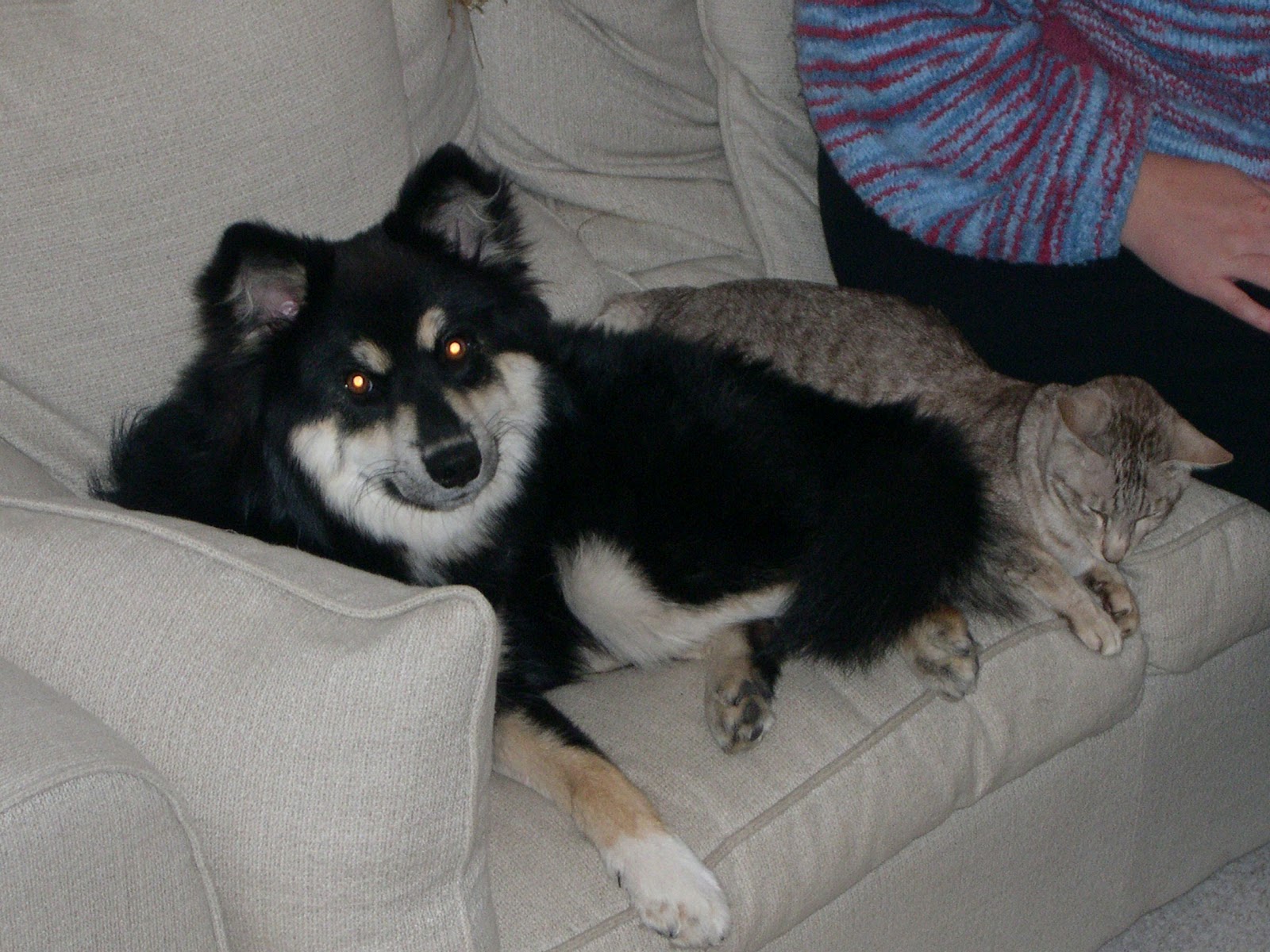
And then we decided that having the animals on the furniture was actually ok with us. Just as well.
If you don't want your dog jumping on people, then don't let the tiny puppy jump up either. The same goes for letting the tiny puppy chew your fingers. At first it's quite cute. Then it really isn't. In fact, the same goes for chewing anything. Decide what your puppy is allowed to chew, which rooms he is allowed to use, whether or not he is permitted upstairs, and then enforce the rules rigidly. Rigidly. Don't make exceptions - ever.
Why not? Because the important thing with all matters of successful dog training and raising a well-mannered, well-behaved adult dog is consistency. Do the same thing everytime and demand the same behaviour of your dog all the time and at all occasions. The bottom line is this: your dog will do whatever you teach him to do, and whatever you allow him to do. If you allow him to do something once, he will think he can do it forever. So be careful to only ever let your puppy learn what you want your adult dog to be.

Tuesday, 25 January 2011
7 weeks old
It's been a busy time but the puppies are doing what puppies tend to do: they are growing up. Getting more demanding as they learn about housetraining and more noisy as they learn just how hard they can bite each other's ears before all hell breaks loose.
They are also getting very fluffy and their ears are starting to come up. In fact, Marja (Marilyn) had one ear up and one ear down today, so hers are just about up all the way.
Since the last update who goes where has all been settled, and so we know for sure who's who. We still don't know if the Kennel Club will approve the names, but we live in hope.
And speaking of names ... I do know better than to settle on Finnish puppy names without first consulting my Finnish friends. Yes, of course I do. So, did I consult any of my Finnish friends before agreeing the pups' new families choice of names? Er, no.
Apparently one or two names might be a little amusing in Finnish. We can live with that.

Kuura (Junior)
Kuura means "frost" and is part of his sire's name.


Bo (Budgie)
Bo is not a Finnish girl's name - and don't believe the online naming sites if they tell you so. It's a Swedish boy's name. But we don't mind, she's still Bo to us.


Sonni (Kicker)
Sonni means "bull" but this one is not a bit stubborn or clumsy. At home he'll be called Buddy.


Tippi (Honey)
Tippi is a Swedish name, but it's also a Finnish word meaning "tip" as in to tip a waiter. Any waiter would be lucky!


Marja (Marilyn)
Marja means "berry".

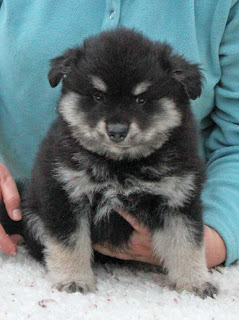
Ukko (Kuusi)
Ukko is the Finnish god of the sky and the natural world.


Sisu (Vee)
Sisu means "perseverance". Aptly named puppy. That's all I'm saying.

They are also getting very fluffy and their ears are starting to come up. In fact, Marja (Marilyn) had one ear up and one ear down today, so hers are just about up all the way.
Since the last update who goes where has all been settled, and so we know for sure who's who. We still don't know if the Kennel Club will approve the names, but we live in hope.
And speaking of names ... I do know better than to settle on Finnish puppy names without first consulting my Finnish friends. Yes, of course I do. So, did I consult any of my Finnish friends before agreeing the pups' new families choice of names? Er, no.
Apparently one or two names might be a little amusing in Finnish. We can live with that.

Kuura (Junior)
Kuura means "frost" and is part of his sire's name.


Bo (Budgie)
Bo is not a Finnish girl's name - and don't believe the online naming sites if they tell you so. It's a Swedish boy's name. But we don't mind, she's still Bo to us.


Sonni (Kicker)
Sonni means "bull" but this one is not a bit stubborn or clumsy. At home he'll be called Buddy.


Tippi (Honey)
Tippi is a Swedish name, but it's also a Finnish word meaning "tip" as in to tip a waiter. Any waiter would be lucky!


Marja (Marilyn)
Marja means "berry".


Ukko (Kuusi)
Ukko is the Finnish god of the sky and the natural world.


Sisu (Vee)
Sisu means "perseverance". Aptly named puppy. That's all I'm saying.

Monday, 19 April 2010
house training poll
With the last litter, the first puppy clearly asked to go outside for a poo at the age of 5 weeks, 4 days. Today, remarkably, at 5 weeks and 1 day, the first of this litter clearly asked to go out. Usko (Dino) and one other run around squawking when they need to go, but one puppy clearly stood up at the bars of the pen and yapped in the direction of the patio doors and the great outdoors. So, quick poll: who was the first puppy to ask to go outside for a poo?
You have until Thurs night to vote.
I have the puppies' weight update as well as some cute photos and videos which I'll try to get around to sorting out tomorrow, but my to-do list is steadily growing after a very full day today, so you may have to bear with me on that one.
You have until Thurs night to vote.
I have the puppies' weight update as well as some cute photos and videos which I'll try to get around to sorting out tomorrow, but my to-do list is steadily growing after a very full day today, so you may have to bear with me on that one.
Subscribe to:
Posts (Atom)